
The tournament engine your venue already owns
Switch it on for the season, or for one event. Your players and your courts are already in it.
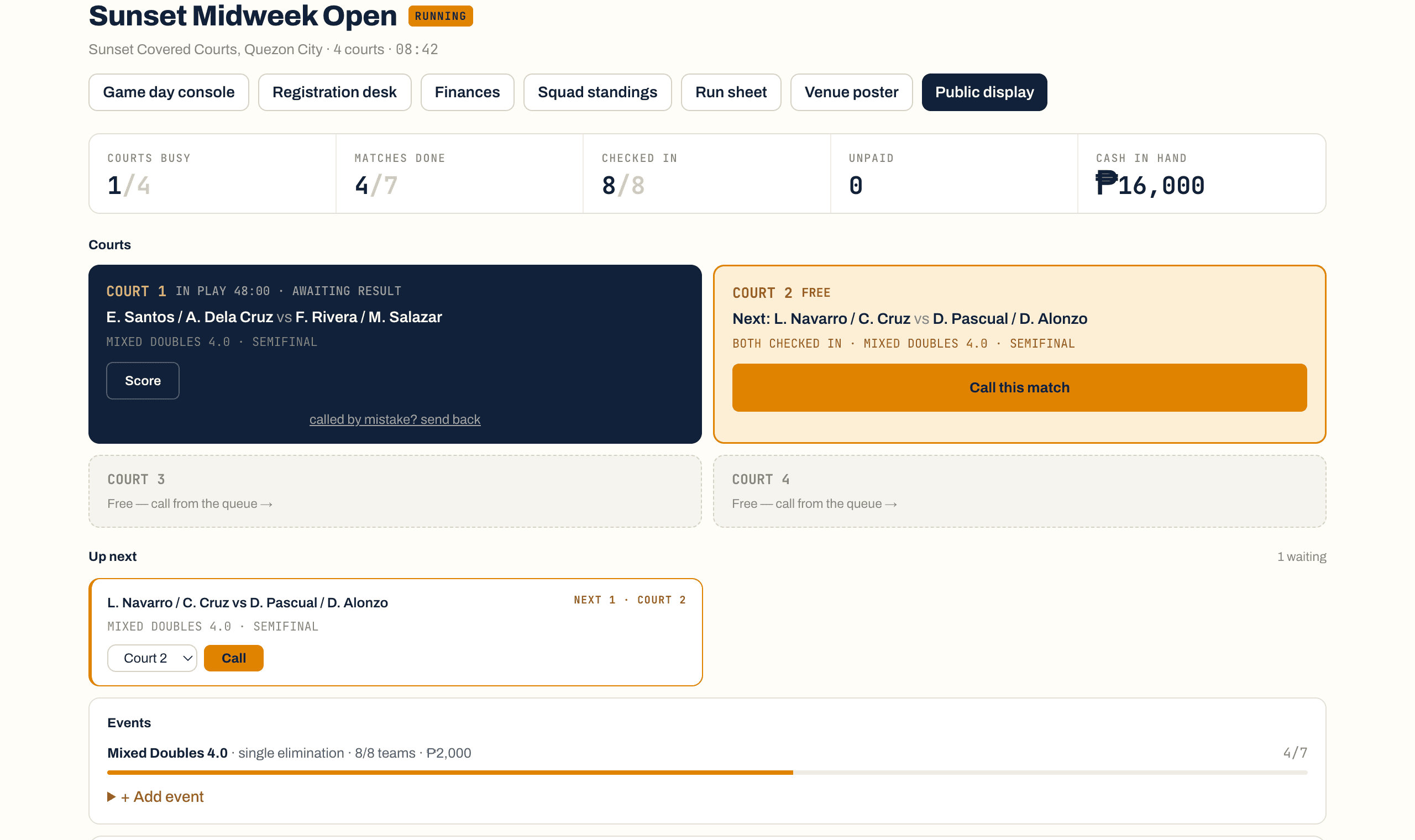
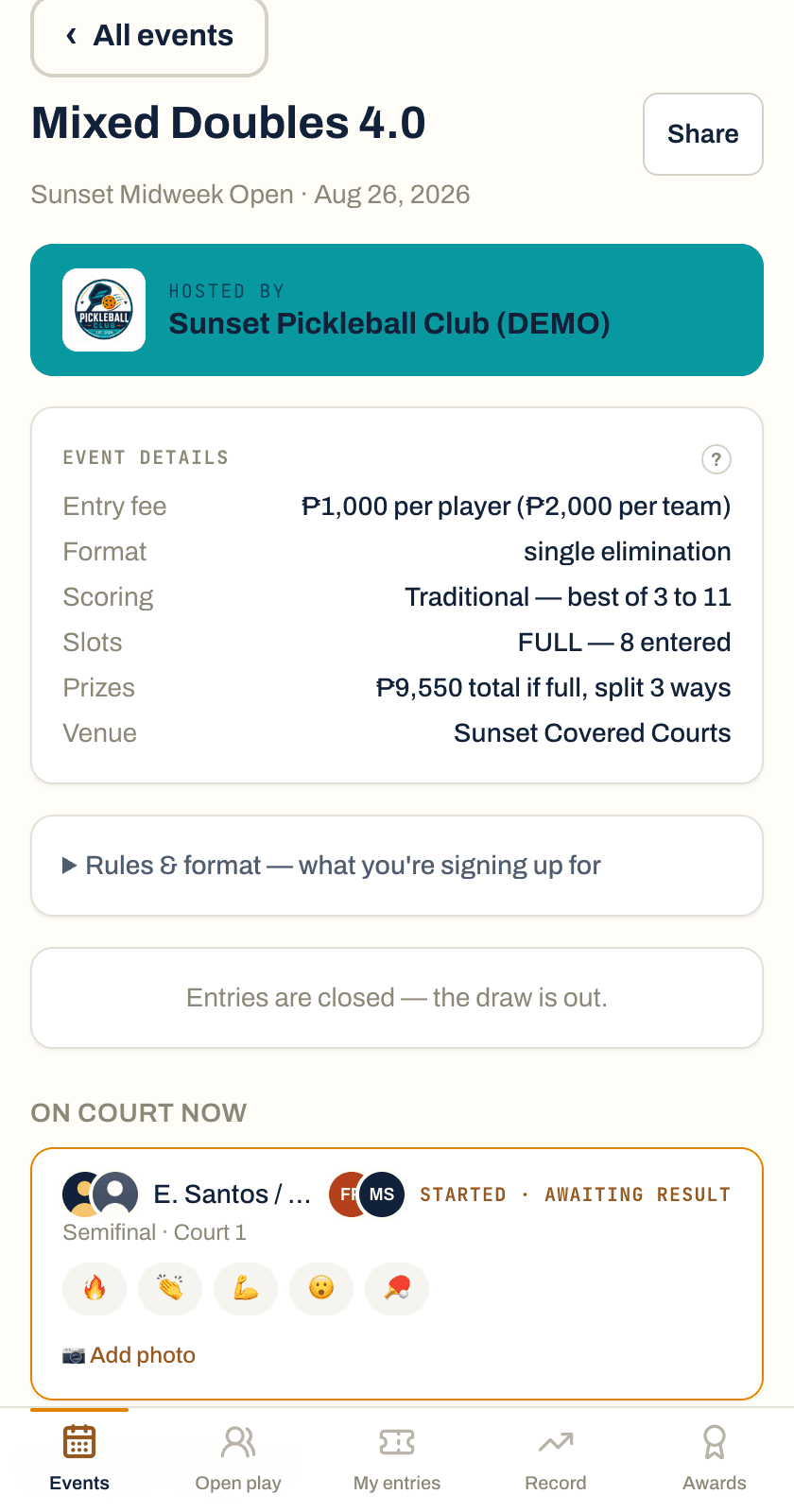
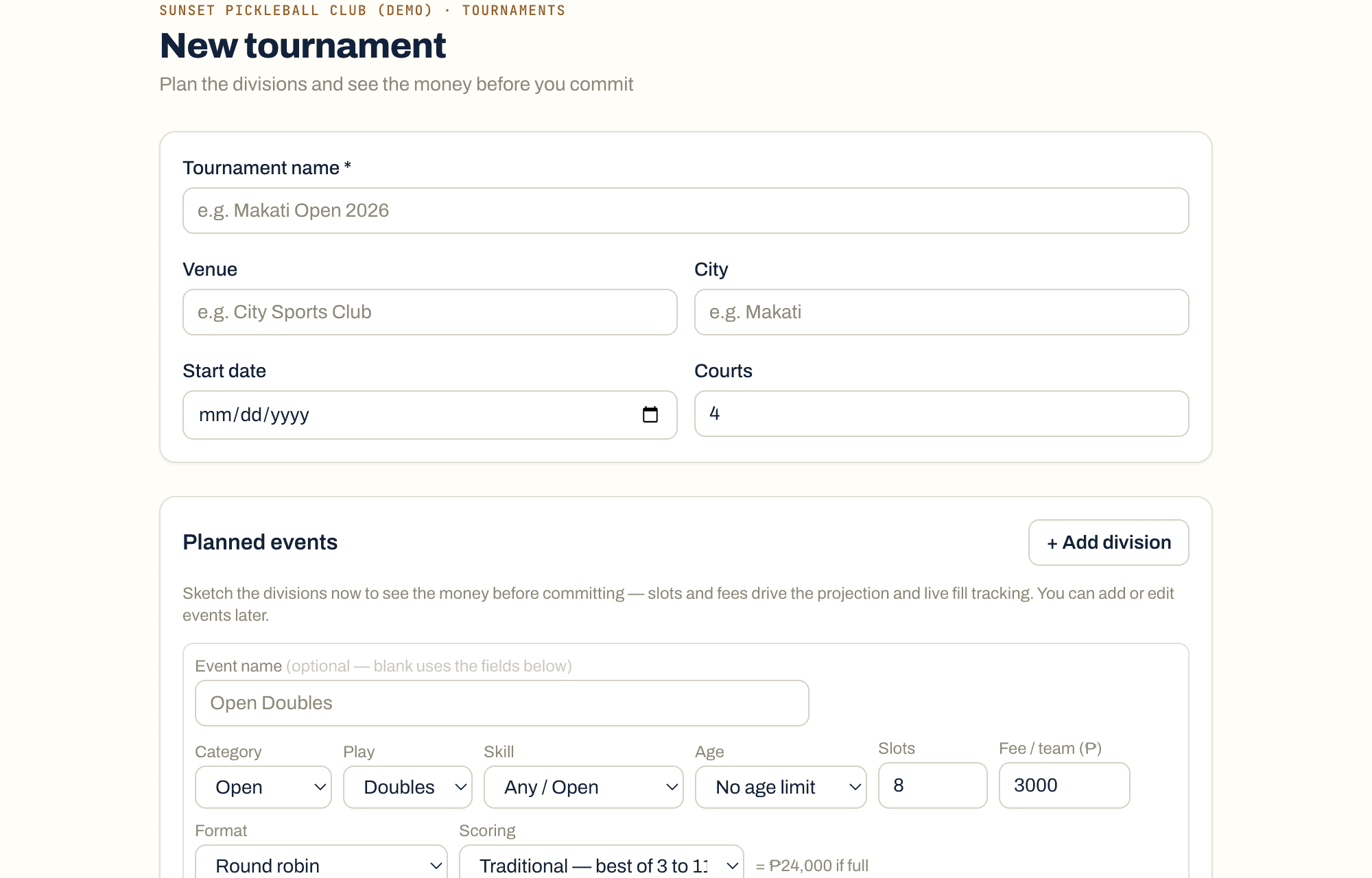
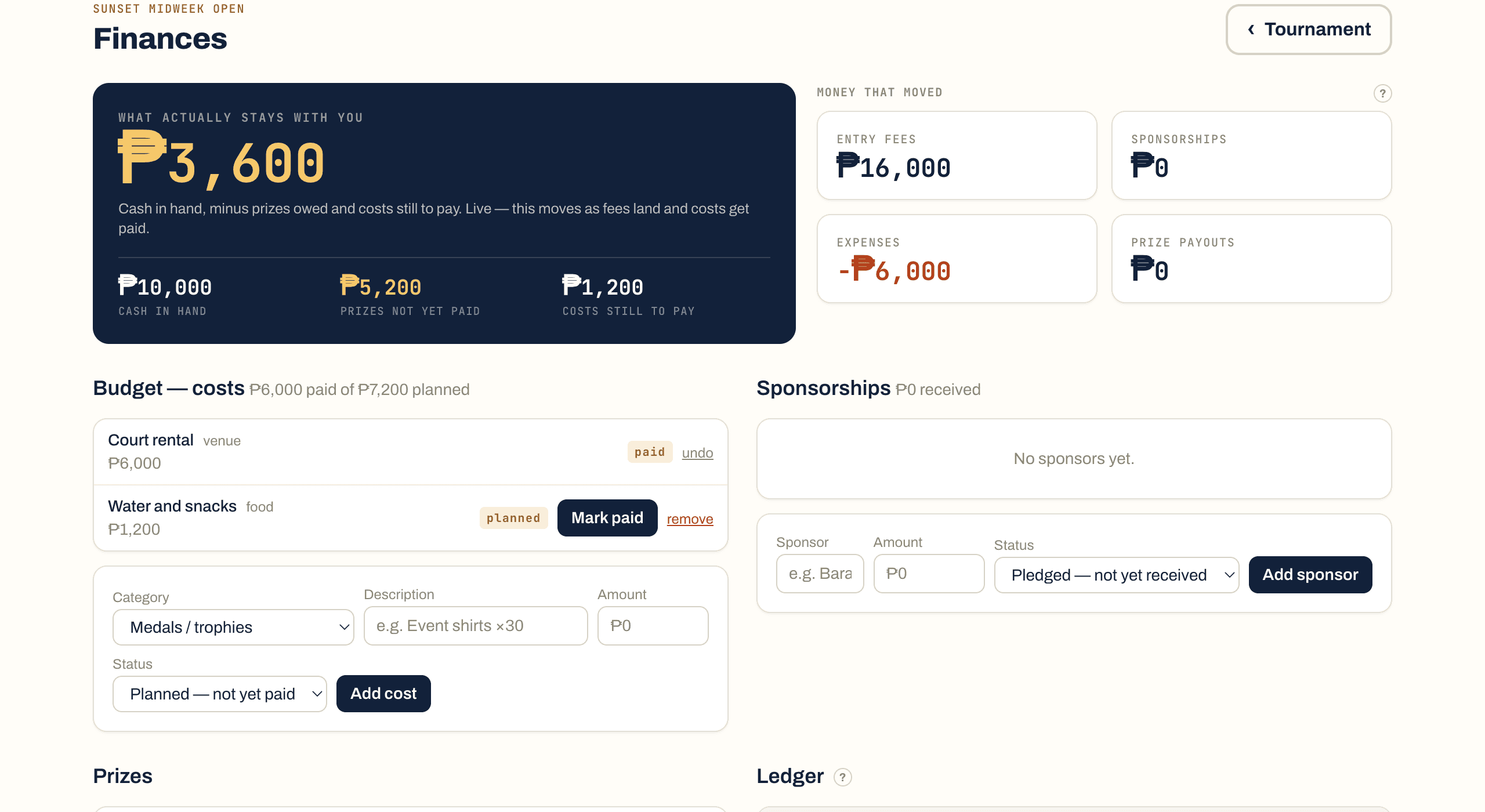
Every screen on this site is DinkDesk itself, running on our demo club — real software, not a real club's data.
And on tournament weekend, the same system
Divisions by gender, format, skill band and age; seeded draws that rebuild when somebody withdraws; point-by-point scoring from any phone and a board for the TV. It runs a club team day too — squads spread across the bands, every win banking a point for one running tally. Because it runs on the same club, the entrant who plays on Sunday is the same record as the regular who books court 3 on Tuesday, and the event's takings land in the same ledger.
Before the day
- 5 formats: round robin, single elimination, double elimination, pools into a medal bracket, and Swiss.
- Divisions by gender, singles or doubles, skill band and age bracket.
- Seeded, reproducible draws with byes, rebuilt if somebody withdraws before it starts.
- A waitlist that promotes itself, and solo entrants who can be paired into a partner.
- Close a division to online entry the moment it is full, without closing the rest of the tournament.
- Rename an event after the draw is out — the bracket, the scores and the entries all stay where they are.
- Your event appears on the shared player board next to every other club's.
A club team day, not just a bracket
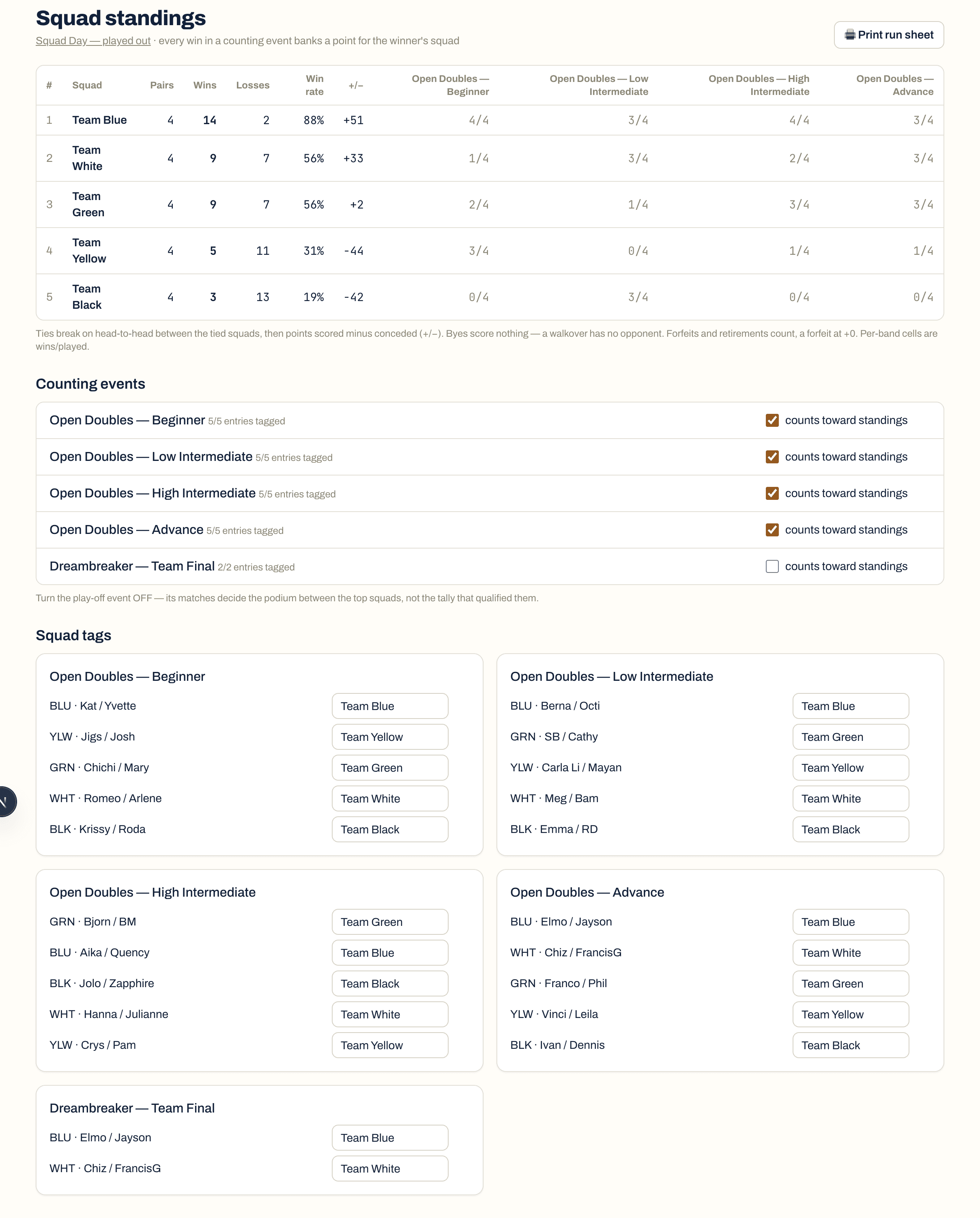
- Every entry can carry a squad tag, so one field of pairs is also a set of teams. The divisions run their own draws exactly as they always did.
- Every win in a counting event banks a point for the winner's squad, and the table is recomputed from the matches on every load — there is no tally for anybody to keep.
- Ties break head-to-head between the tied squads, then on points scored minus conceded.
- Byes score nothing and two pairs from the same squad score for nobody, so the draw cannot decide the day.
- Switch the play-off event out of the tally, so the final cannot rewrite the qualification that produced it.
- An entry with no squad yet is named on the board, along with how many finished matches went uncounted while it sat untagged.
- Your players read the same standings, and their own order of play, on their phones.
On the day
- The door lists every team with what they still owe, so nobody is checked in by accident without somebody seeing it. Checking them in anyway is your call — the person is standing there — and it is on the record either way.
- A match cannot be called until both teams are checked in. Calling one anyway is a deliberate override, not the default.
- The desk shows which courts are free and which match is ready, so calling the next one is a decision the screen already made.
- A stripped-down console for the person actually walking the courts: every court and the queue on one screen, and a result is two taps. No menus, nothing to configure, nothing on it that can wreck the draw.
- Three ways onto it — you signed in, the club's counter tablet on a staff PIN, or a committee code on a volunteer's own phone. No accounts created on the morning of the event.
- Your committee codes each carry a QR: a volunteer points a camera at it and is on the console with nothing typed, not a code and not a name. Revoke the code and every phone holding it is signed out.
- The codes screen says how many phones are actually on right now, and whose.
- Ending somebody's tournament is not a volunteer's call: a forfeit is yours or your director's, never the counter tablet's or an ordinary committee code's — and no door on the console can withdraw, refund, void or edit a draw.
- 13 scoring presets: side-out, rally, freeze at 20, timed.
- A court that has been started but has no point on it yet says “started, awaiting result” — on the boards, the consoles, the run sheet and the players' phones — instead of looking idle for twenty minutes.
- Every score change is kept in an audit trail.
A day that runs to a clock
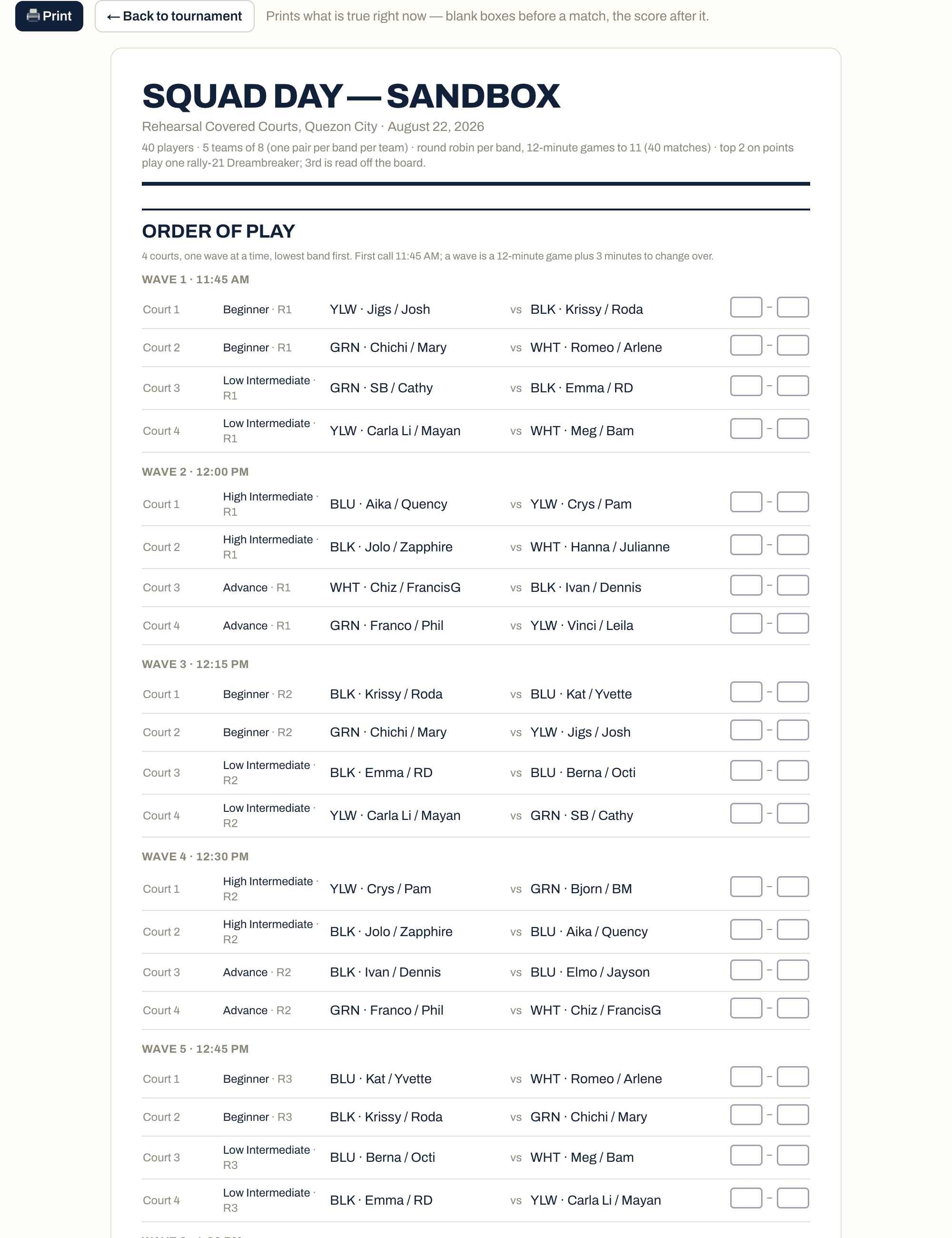
- Matches queue round by round, lowest band first, so four free courts do not all fill with the same division.
- Call the whole next wave onto every free court in one tap.
- One countdown for the whole room on timed games. The courts console starts it; every score pad and the wall show the same numbers, counting against the server's clock rather than their own, so a tablet that has drifted cannot argue with the buzzer.
- Rotate the pairs on court every so many combined points — your number, set on the event — and every screen asks for the switch at the same moment.
- The clocks are advisory on purpose: the referee's tap is the buzzer, and nothing on the server ends a game on elapsed time by itself.
When the day does not go to plan
- A partner pulls out after the draw: swap the player on the entry and the team keeps its place, its matches and its court. If the person coming in already holds another entry in the same division, the two are traded.
- A match called onto the wrong court is sent back, from the console tile, the court card or the court page.
- A pair already on a court cannot be called onto a second one — checked on your own screen and on the console, and never waived by a force button.
- A forfeit or a retirement is two taps and the bracket keeps moving.
- Rehearse the fix instead of testing it on the real day: “Create test copy” clones the tournament exactly as it stands — events, draws, squad tags, check-ins, every score, whatever is on court — into a twin you are free to break.
- The copy is inert by construction: it notifies nobody, moves nobody's rating, refuses to print certificates, never reaches the player board or the club's books, and does not count against your plan. Deleting refuses anything that is not a copy.
The screens around it
- A full-screen board for the venue TV.
- The same address opens on a phone as a spectator's screen, with the called matches first — somebody who scanned the poster wants to know who is on next, not to scroll past a court grid.
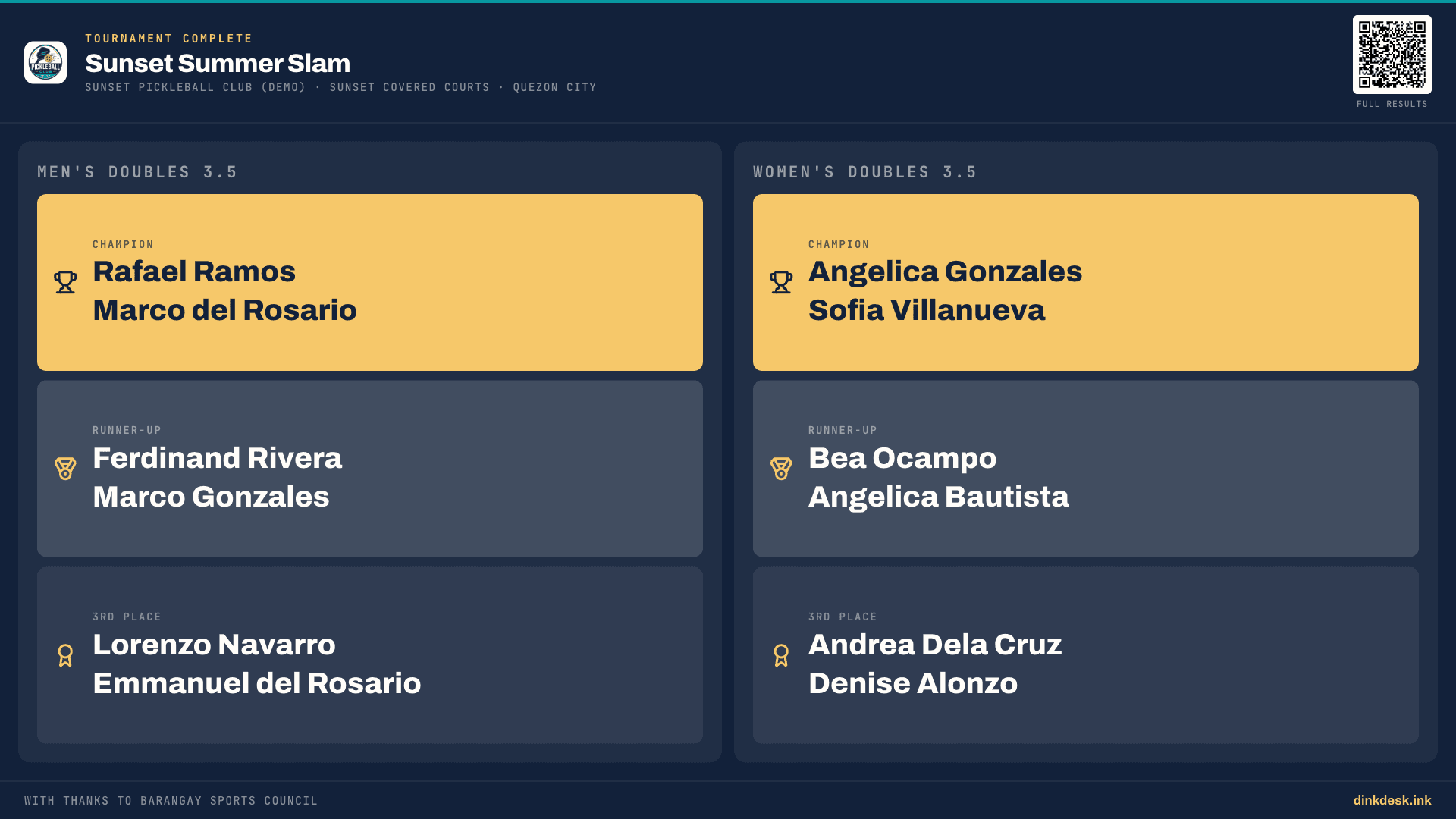
- When the last match is decided the wall turns itself into the champions screen: the podium of every division, full-bleed, paging through them.
- A printable run sheet for the wall — every matchup with blank boxes for the referee to write the score into, the scores filled in once they exist, and the squad standings on top. It is recomputed every time you print it, so there is no stale copy pinned up anywhere; on a squad day it prints as waves, one line per court, in the order the console calls them.
- A printable QR poster that drops a player straight into your draw.
- A player-facing board with divisions, entry fees and what is on court now.
- 22 certificate designs across champion, runner-up, third place and participation, filed into each player's own account.
- Every one of those addresses is listed on the console that runs the day — what to open on the TV, what the marshal's tablet uses, what to send the players — instead of being a link somebody has to remember.
- On a subscription, your club's logo and colour carry across all of them, including the poster and the certificates — not on the free trial and not on the DinkDesk Tournament Pass.
What the event made
- Entry fees, expenses, sponsorships and payouts in one ledger.
- 5 prize models, all computed from fees actually collected — the podium can never promise money that is not in the tin.
- A break-even line, while you can still do something about it.
- Planned budget kept apart from what actually happened.
- And it rolls up into the club's own revenue alongside the courts and the counter.
The seven questions this always comes down to.
- Our club day is not a bracket. It is five teams.
- Then tag every entry with its squad. Each division still runs its own draw, every win in a counting event banks a point for that entry's squad, and the table rebuilds itself out of the matches — on your screen, on the printed run sheet and on your players' phones, with nobody adding up a tally on paper. Ties break head-to-head between the tied squads, then on points scored minus conceded, and the play-off can be switched out of the count so the final does not rewrite its own qualification.
- Something will go wrong at 11am and I will be terrified to touch it.
- Make a test copy first. One button clones the tournament exactly as it stands — draws, squads, check-ins, every score, whatever is on court — into a twin nobody else can see. It sends no notifications, moves no ratings, prints no certificates, never appears on the player board and does not count against your plan. Try the fix there, then do it for real.
- Somebody's partner pulls out on the morning.
- Swap the player on the entry. The team keeps its place in the draw, its matches and its court — nothing is redrawn — and if the person coming in already holds another entry in the same division, the two are traded. It is refused once an affected entry has a result or a match in progress, because at that point a forfeit and a fresh entry is the honest record.
- I run three tournaments a year. Do I have to subscribe?
- No. Arrange it with us for one event at ₱1,500 and we switch it on for that event — there is no button for it, because we set it up by hand. Past about eight events a year the ₱1,000 monthly module is cheaper, and we will tell you when you get there.
- I do not own a venue at all.
- Then you do not need one. The DinkDesk Tournament Pass is ₱2,500 for one tournament and 30 days, with no subscription and no courts.
- Does it talk to DUPR?
- No. Players carry a DinkDesk rating, which is ours, moves on every recorded result and can gate entry into a capped division. It is not a DUPR rating and we do not sync one.
- Can players pay online?
- Not through us. They pay you — GCash, Maya, bank transfer or cash at your desk, against your own accounts — and your desk confirms it. We never touch an entry fee and never take a cut of one.
It is one club, so these are one record.
The person who books a court is the person who buys a drink, joins Thursday's open play and enters September's tournament — without anybody typing a name twice.
Tournaments switch on for a season, or for one weekend.
₱1,000 a month on a venue that runs events regularly, ₱1,500 for a single event if you do not — or ₱2,500 for the DinkDesk Tournament Pass if you have no venue at all.
Try it first: 2 rentable courts, the cashier and one complete tournament, free, for at least 30 days.