
Court bookings that hold up on a Saturday
One grid for the whole day. Tap an empty slot to book it; drag a booking to move it.
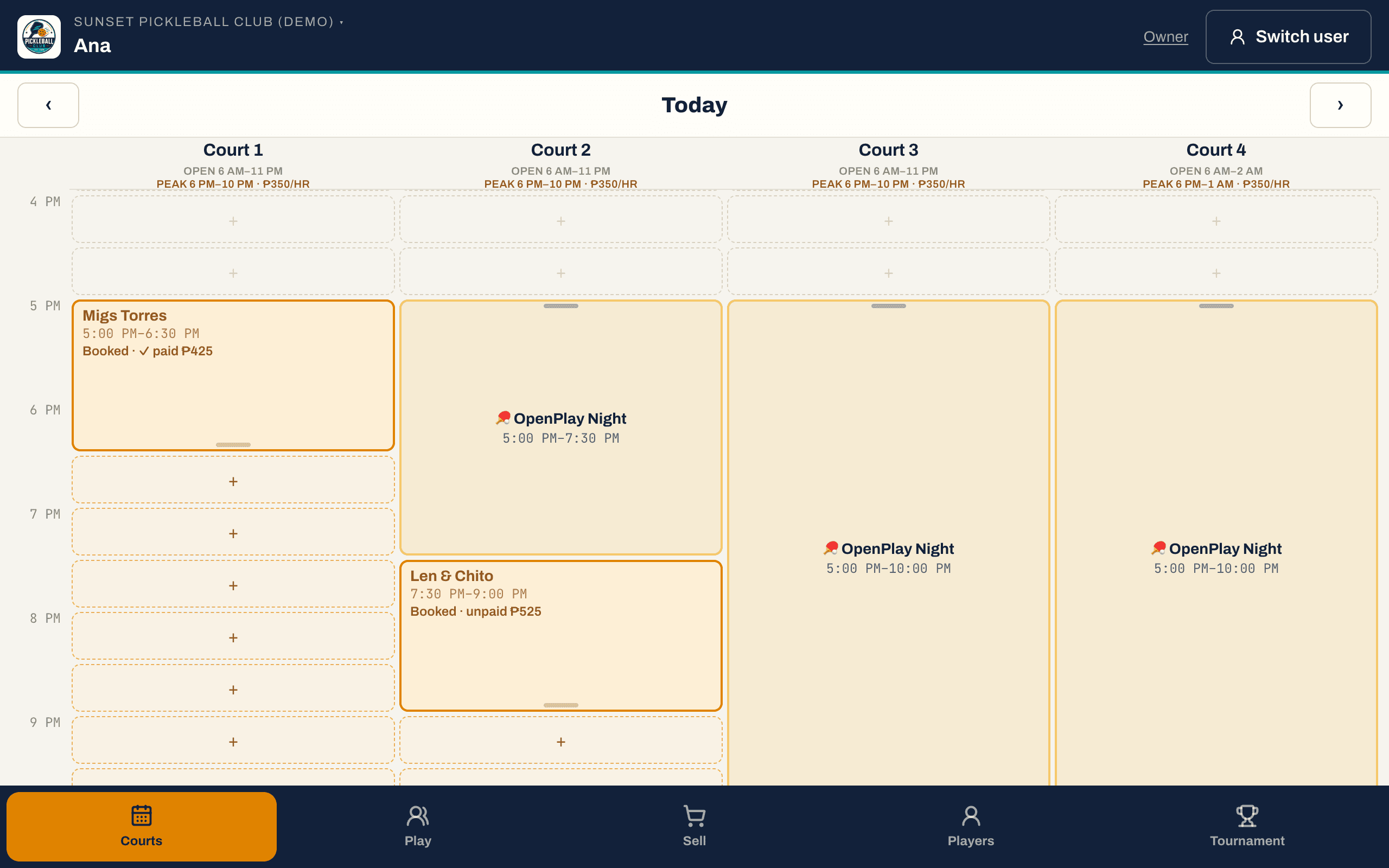
Every screen on this site is DinkDesk itself, running on our demo club — real software, not a real club's data.
Every court, every hour, on one grid
Your courts carry their own opening hours and a base and peak hourly rate. A walk-in needs a name and nothing else; a regular is picked off your player list. The price is worked out from the court's rate at the moment it was booked, so raising your rates next month never rewrites what somebody was already quoted.
The day
- Every court in one column-per-court grid, in half-hour slots.
- A line across the grid marking the current time, and the day it belongs to.
- Opening and closing hours per court — including courts that close after midnight, which the form explains while you type it.
- Retire a court and it takes no more bookings while keeping every one it ever had.
Taking the booking
- A walk-in is a name and, if you want it, a phone number. Both can be blank: the guy on court 2 who paid cash is still money.
- A regular is picked off the club's player list, so the booking lands on their record.
- A full name typed into the form files that person into your player directory as it is taken, so next Saturday's booking finds the same human being instead of starting another line of text. It never refuses a rental over it: a one-word name simply stays free text.
- A standing Tuesday group is a weekly repeat, cancelled as a series when it ends.
- Notes on the booking, for the things a grid cannot hold.
- 5 states a booking can be in — booked, checked in, done, no-show, cancelled — so "did they turn up" is a fact, not a memory.
The money on it
- A base hourly rate and an optional peak window per court, in centavos.
- The amount due is stamped at booking time and never recalculated.
- Paid at the counter by cash or GCash, with the reference and the name of whoever took it.
- Part-paid and unpaid bookings are visible as such on the grid, in colour, from across the counter.
- Rained out? The counter can hand the money back on your PIN, with the reason tapped from a list — and the drawer's expected cash drops in the same breath, so the cash-up still balances.
Moving things when the day changes
- Drag a booking to another court or another hour.
- Drag its bottom edge to stretch it when they want another half hour.
- Sweep across empty slots to block a stretch of court out.
- The same grid on the owner's console and on the counter tablet — one screen, two doors.
The six questions this always comes down to.
- What stops two people booking the same court?
- The grid. A slot that is taken is a filled block on the court's column, and the booking form works from the same data — there is one place a booking can live, and it is on screen in front of whoever is taking the next one.
- Most of my customers just walk in.
- Then most of your bookings are two taps: the empty slot, and a name. Nothing about walk-ins is a second-class path — they are priced, paid and checked in exactly like a reservation, and they show on the same grid.
- I charge more at night.
- Each court carries a peak window and a peak rate. A 6pm booking bills at the peak rate and a 2pm booking does not, without anybody remembering to change anything.
- Can my customers book a court themselves, online?
- No — and this is the one place a pure booking app beats us today. Court bookings are taken by your desk or by you, on the grid. Players do reserve their own open play spots and enter their own tournaments from their phones; self-service court booking is not built, and we are not going to imply it is.
- What stops open play being booked over?
- An open play session books the real courts it runs on, for the hours it runs, so those blocks are occupied on the same grid and nothing else can take them.
- Can I see whether the courts are actually paying?
- Hours booked, utilisation and booked value per court, over any date range you pick, plus the three busiest hours of the day. It is on the club revenue screen with everything else.
It is one club, so these are one record.
The person who books a court is the person who buys a drink, joins Thursday's open play and enters September's tournament — without anybody typing a name twice.
Court rental comes with the venue, not on top of it.
DinkDesk Venue is ₱1,499 a month for court rental and the cashier — they are the same purchase, because they are the same counter. Open play and tournaments are switches you add later if you run them.
Try it first: 2 rentable courts, the cashier and one complete tournament, free, for at least 30 days.